If your property along the Chunky River corridor has gone from open pasture to a wall of sweetgum, privet, and scrub pine, you already know what encroachment costs — in time, in lost grazing acres, and in the creeping feeling that your land is working against you instead of for you. ARF LLC provides professional forestry mulching services across Newton County and the surrounding region, returning overgrown timber tracts, neglected hunting land, and brushy acreage to useful, accessible ground. We’re a locally rooted land solutions company based right here in Hickory, MS — call (601) 527-8405 for a free on-site estimate.
What Forestry Mulching Actually Involves
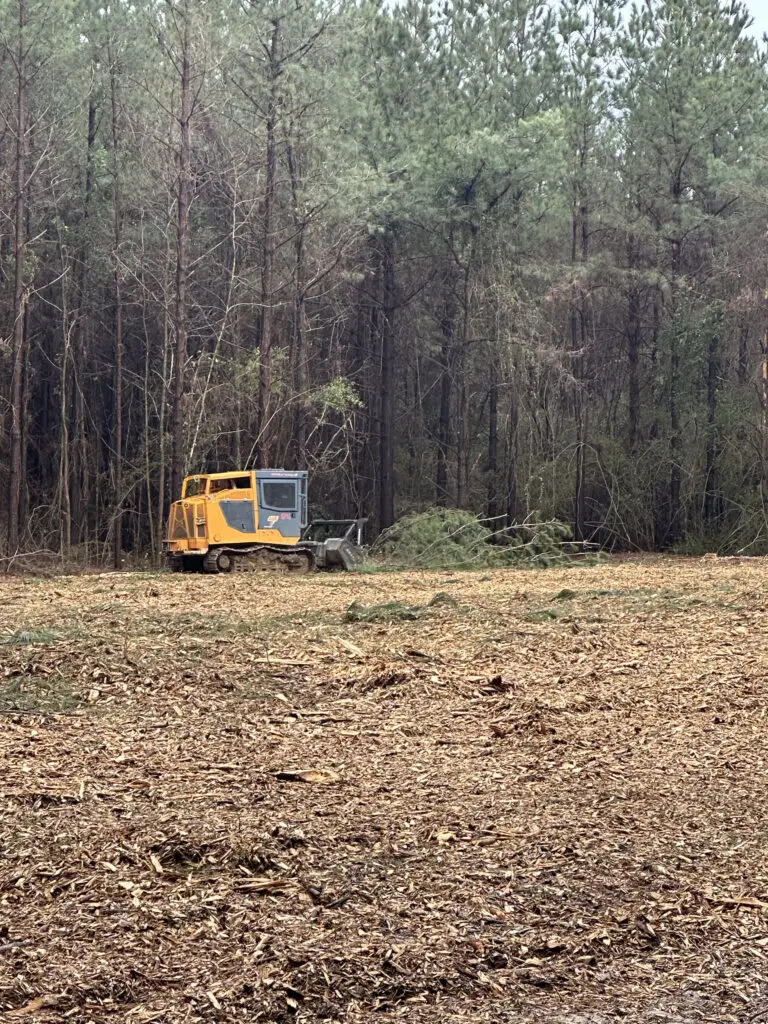
Forestry mulching is a single-pass land clearing method that uses a high-horsepower tracked machine — typically a dedicated mulcher or an excavator fitted with a drum mulching head — to cut, shred, and grind standing trees, brush, and undergrowth directly in place. Unlike traditional clearing methods that strip a site bare with a dozer and leave you with burn piles, hauling costs, and bare, erosion-prone soil, mulching processes everything on the spot. The rotating drum carries rows of carbide-tipped teeth or hammers that spin at high speed, attacking vegetation from the canopy down to root-crown level. Larger stems get shredded into coarse chips; lighter brush becomes fine mulch that immediately blends into the soil surface. Because the machine operates on tracks, ground disturbance is minimal — Newton County’s clay-loam soils, which compact easily under wheeled equipment, stay structurally intact. What you’re left with is a clean, walkable property with a thin mat of organic mulch that suppresses weed regrowth, reduces erosion on slopes, and breaks down over one to two seasons to add nutrients back into the soil. For landowners in communities like Decatur, Union, and Newton — whether they’re reclaiming a hunting lease, opening pasture for cattle, or preparing a tract for house pad construction — forestry mulching is typically the most cost-effective and environmentally sound option available.
Our Forestry Mulching Process
Step 1 — On-Site Property Evaluation
We begin every project with a free on-site walkthrough, not a phone estimate. Our crew walks the boundary lines, assesses stem density and species composition, identifies any desirable trees or vegetation the landowner wants preserved, and checks for drainage features, fencing, or buried utilities that need to be worked around. This lets us price the job accurately and plan the safest, most efficient path through the property.
Step 2 — Project Scoping and Equipment Selection
Based on the evaluation, we select the right equipment configuration for your conditions. Dense stands of hardwood or large-diameter softwood may call for our tracked mulching unit with a high-torque drum head; lighter brush and understory work may be handled more efficiently with a different attachment. We confirm the scope with you before any machine touches the ground.
Step 3 — Systematic Mulching and Selective Clearing
Our operator works through the property in deliberate passes, maintaining the ground stability and topsoil integrity that Newton County’s Coastal Plain soils require. Trees, brush, and stumps up to a manageable diameter are processed in a single pass. Any specimen trees, fence lines, or specific areas the landowner marks are bypassed cleanly. The machine’s low ground pressure minimizes rutting — important in the wet months that can settle across central Mississippi from November through March.
Step 4 — Cleanup and Property Walk-Through
Once the mulching run is complete, our crew does a final pass to address any remaining large-diameter wood, oversized stumps, or areas the landowner wants thinned further. We walk the property with you before we load out to confirm you’re satisfied with the result. If adjustments are needed, we handle them on the spot.
Step 5 — Site Hand-Off
You take delivery of a cleared, mulched property with functional ground access — no burn ash, no log piles to deal with, no erosion scar. Landowners across Newton County who’ve been watching their pasture shrink into timber for years walk away with a property that’s ready for whatever comes next: fencing, food plots, a building pad, or simply clean, open hunting land.
Serving Hickory and the Surrounding Area
ARF LLC’s forestry mulching crews work throughout Newton County and neighboring counties, including projects in Newton, Decatur, Union, Lake, and the rural communities of Chunky and Conehatta. We regularly work properties along MS-503, US-80, and the I-20 corridor — timberland tracts that have been cut over and grown back, old farmsteads reclaiming themselves in pine and sweetgum, and hunting properties that need food plots and access roads opened back up. Newton County sits in Mississippi’s Coastal Plain, a region of moderate to dense pine-hardwood mix with clay-loam soils that reward careful, low-disturbance clearing. Our approach to land solutions in Newton County is built around that — equipment and technique matched to what the ground here actually requires. Reach us at arfllc.com or call (601) 527-8405 to discuss your property.
Why Newton County Landowners Choose ARF LLC
ARF LLC has been operating in Newton County since 2020, building a track record on the kind of land that defines this part of Mississippi: mixed timber, rolling terrain, clay soils, and landowners who know the difference between a crew that takes their land seriously and one that doesn’t. We’re listed as a registered forestry vendor with the Mississippi Forestry Commission — one of a limited number of operators in the region to hold that designation — which reflects both our standing in the industry and our commitment to responsible land management practices. You can learn more about our crew at arfllc.com/about.
We run modern, well-maintained equipment configured for the conditions common across east-central Mississippi. Our operators understand that forestry mulching done right means protecting the topsoil structure, not just knocking down the brush. For landowners dealing with invasive species — Chinese privet, kudzu, and native scrub that’s gotten out of hand — we approach vegetation management with the goal of giving the land a fighting chance at natural recovery. For a free estimate, request a free estimate at arfllc.com/contact or call us directly.
For more on sustainable forestry practices and how mulching compares to conventional clearing, the MSU Extension Service’s forest soils research (extension.msstate.edu) provides useful context on how clearing methods affect soil health in Mississippi’s Coastal Plain region.
Forestry Mulching FAQs
How much does forestry mulching cost in Mississippi?
Forestry mulching in Mississippi typically ranges depending on vegetation density, tree diameter, terrain difficulty, and site accessibility. Lightly brushed land or open understory clears faster and costs less per acre; dense hardwood stands or properties with heavy vine cover require more machine time and carry a higher per-acre rate. ARF LLC prices each job based on an on-site assessment — call (601) 527-8405 for a free estimate on your specific property.
Is forestry mulching better than bulldozing?
For most Newton County landowners, yes. Bulldozing strips topsoil, leaves root masses that require burning or hauling, and often causes significant erosion on sloped terrain. Forestry mulching processes vegetation in place, leaving a mulch layer that protects the soil surface, suppresses weeds, and adds organic matter as it breaks down. It also costs less because there is no debris removal. The main exception is if you need the land graded flat — in that case, a mulching pass followed by grading and dirt work is typically the right sequence.
What size trees can a forestry mulcher handle?
A purpose-built tracked mulcher handles trees up to roughly 6 to 8 inches in diameter in a single pass. Larger diameter trees — mature hardwoods or dense pine stands — may require a different attachment or pre-felling before mulching. During our site walkthrough, we assess what equipment configuration is right for your tree composition and confirm what the machine can process efficiently.
Will forestry mulching damage the soil?
When done correctly, forestry mulching is one of the least disruptive clearing methods available. Tracked equipment with low ground pressure limits compaction, and the mulch layer left behind actually protects the soil surface from erosion and moisture loss. In contrast, conventional clearing with wheeled equipment or dozers on wet clay soils — common conditions across Newton County in winter and spring — can cause significant compaction and erosion. We schedule work around soil conditions when possible.
Does ARF LLC handle hunting land and pasture reclamation?
Yes. Hunting land clearing and pasture reclamation are two of our most common forestry mulching projects. We open food plots, cut access roads and shooting lanes, remove invasive species taking over native browse, and reclaim grown-up pasture ground for cattle operations. If you’re working toward a specific land management goal — timber stand improvement, wildlife habitat enhancement, or pasture restoration — let us know at the estimate stage and we’ll plan the clearing approach accordingly.
How long does a forestry mulching job take?
A skilled operator running the right equipment can clear one to three acres per day under typical Newton County conditions — light to moderate brush. Denser vegetation, large-diameter trees, or difficult terrain will slow that rate. We’ll give you a realistic timeline at the estimate stage based on your actual property conditions, not a generic number.