
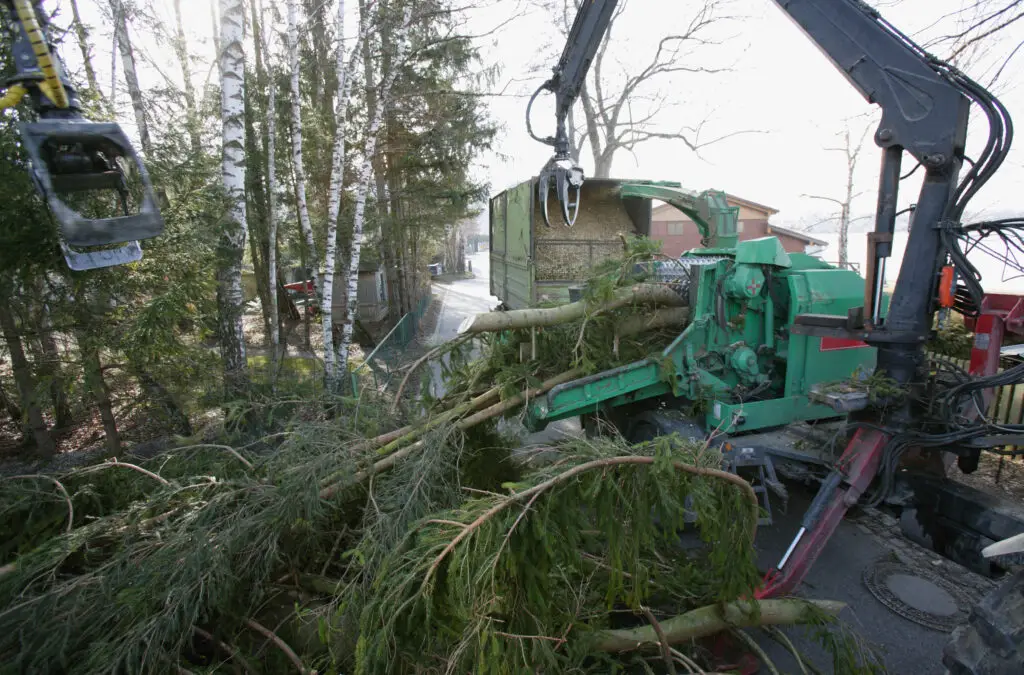
When a storm comes through Newton County and drops a pine tree across your driveway, blocks your access road, or lays timber across a fence line, you don’t have time to wait for a callback next week. ARF LLC provides storm cleanup services across Newton County and the surrounding region, available 24 hours a day, 7 days a week — including nights, weekends, and holidays. We run equipment capable of handling everything from a single downed tree to widespread storm debris across multiple acres of property. Call (601) 527-8405 the moment you need us. We answer.
What Storm Cleanup Actually Involves
Storm cleanup is the process of clearing fallen trees, broken limbs, uprooted root masses, scattered brush, and structural debris from a property after severe weather — and getting it done fast enough that the damage doesn’t compound. A tree across a road is an access problem. A downed tree on a fence line is a livestock problem by morning. Timber blown down across a building site doesn’t get cleared by a phone call scheduled three days out.
Newton County sits in a part of Mississippi that sees its share of severe weather — thunderstorms that topple mature pines, ice events that split hardwood crowns and bring down limbs across driveways and pastures, and occasional tornado-strength wind events that can level sections of timber in minutes. When that happens, the priority is access, safety, and getting the property functional again.
ARF LLC’s storm cleanup work covers the full scope: fallen tree removal and cutting, root mass extraction, debris clearing from roads and access points, fence line clearing, property access restoration, and mulching or hauling of storm debris depending on what the landowner needs. For larger storm events that damage standing timber, we can coordinate debris clearing in a way that preserves salvageable logs and protects the residual stand — important for landowners who have a meaningful timber investment at stake.
Our Storm Cleanup Process
Step 1 — Emergency Response and Initial Assessment
When you call, we get someone on the phone — not a voicemail box. We assess the situation with you, determine what equipment is needed, and give you a clear timeline for arrival. For access emergencies — a road blocked, a structure at risk, livestock exposed — we prioritize response time above everything else. Our crew covers Newton County and neighboring counties and can mobilize quickly from Hickory, MS.
Step 2 — Hazard Identification and Safe Work Setup
Before any chainsaw or equipment touches the debris, we identify hazards. Downed trees under tension from weight or root mass can move unpredictably when cut — a common cause of serious injury for landowners attempting their own storm cleanup. We also confirm that no downed utility lines are involved before working in the immediate area. If a power line is down or in contact with storm debris, we don’t work until the utility company has confirmed the line is de-energized.
Step 3 — Debris Clearing and Access Restoration
Our crew works through the storm debris systematically — opening blocked roads and driveways first, then clearing fence lines, buildings, and open pasture or timber ground. We use chainsaws, excavators with grapple attachments, and where appropriate, forestry mulching equipment to process debris efficiently in place. For properties with extensive timber blowdown, we assess which logs have salvage value before deciding how debris is handled.
Step 4 — Debris Disposition
Cleared storm debris can be mulched on-site using our forestry mulching equipment — the fastest and most cost-effective option for brush and smaller material. Larger logs are either limbed and left for the landowner’s use, stacked for a logger to assess for salvage, or hauled off-site. Burn piles are an option where conditions and burn permits allow. We confirm the debris plan with you during the initial call so there are no surprises on cost.
Step 5 — Property Walk and Close-Out
Before we leave the site, we walk the cleared areas with the landowner to confirm access is restored and any additional problem spots are identified. If secondary cleanup is needed — storm debris that’s less urgent than the emergency response items — we can schedule that as a follow-up visit. We document the scope of work, which can be useful for insurance claims on storm-related property damage.
Serving Newton County and Surrounding Areas Around the Clock
Storms don’t follow business hours and neither do we. ARF LLC’s 24/7 storm cleanup coverage extends throughout Newton County — Newton, Decatur, Union, Lake, Chunky, Conehatta, and the rural communities throughout the county — as well as neighboring Jasper, Scott, Neshoba, and Lauderdale counties. We work properties along I-20, US-80, MS-503, and MS-15, and we know the terrain out here.
Central Mississippi’s pine-hardwood mix means storm debris isn’t just branches — it’s mature timber with root masses, split hardwood crowns loaded with tension, and thick vine growth that connects one downed tree to the next. Our crew and equipment are matched to that reality. For the full range of land and property services in Newton County, visit arfllc.com or call us directly.
Why Newton County Landowners Call ARF LLC After a Storm
We’re a local crew — based in Hickory, working this county and the ones around it — which means we’re not driving three hours to get to your property and billing you a travel premium for it. When a major storm event hits Newton County, outside contractors flood in and local landowners end up waiting in line. ARF LLC clients get a local crew that’s already here.
We run equipment capable of handling serious storm damage: tracked excavators with grapple attachments for moving large root masses and log sections, chainsaws operated by experienced crew, and forestry mulching equipment to process brush and debris in place rather than hauling it. For our team, see arfllc.com/about.
The MSU Extension Service’s guidance on post-storm debris clearing (extension.msstate.edu) notes that specialized equipment is typically needed to clear large areas efficiently, and that salvageable timber should be evaluated before cleanup begins — both things ARF LLC brings to every storm response job.
Storm Cleanup FAQs
Is it safe to try to remove a fallen tree myself?
In many cases, no — and the Mississippi State University Extension Service explicitly cautions against it unless you’re experienced with chainsaw operation and understand how to read tree tension and fall direction. Storm-felled trees are often under significant stored tension from their own weight and from root systems that haven’t fully released. When cut incorrectly, the log can kick, roll, or swing violently. If the downed tree is on a structure, power line, or fence, the risk is higher still. Call a professional crew with the right equipment.
Do you respond to storm calls at night or on weekends?
Yes. ARF LLC is available 24/7 for storm cleanup emergencies — nights, weekends, and holidays included. Call (601) 527-8405. For access emergencies and safety hazards, we prioritize same-day or overnight response.
What if a power line is down with the tree?
Do not approach the area. Call your utility provider immediately — in Newton County that’s typically Mississippi Power or a local co-op — and do not allow anyone near the downed line until the utility company confirms it has been de-energized. ARF LLC will not work in proximity to a live or unconfirmed downed line. Once the utility confirms the line is clear, we can proceed with tree and debris removal.
Can you help with a timber loss insurance claim after a storm?
We can document the scope of work performed and provide a detailed invoice, which can support an insurance claim or a casualty loss deduction with the IRS. For significant timber stand losses, the MSU Extension Service recommends having a certified forester calculate pre- and post-storm timber value for tax purposes. We can advise on what applies to your situation during the initial assessment.
Do you handle storm cleanup for commercial properties?
Yes. We work residential properties, agricultural land, timber tracts, and commercial sites — if a storm dropped a tree or scattered debris across your property, we can clear it. Commercial property owners with access road blockages or structural debris should call us directly to discuss scope and response time.
How quickly can you be on-site after a storm?
Response time depends on the volume of calls following a major weather event and your location within our service area. For access emergencies and active hazards, we prioritize as fast as possible — often same day or within hours. Call (601) 527-8405 as soon as the storm passes and you’ve assessed what you’re dealing with. The earlier you call, the faster we can schedule response.